
In mechanical systems, choosing the right type of drive directly affects efficiency, durability, and maintenance. Both chain drives and belt drives are widely used for power transmission, but they differ in structure, operation, and performance. This guide compares the two systems in detail, including how each transmits power, handles load, and performs across different industrial applications.
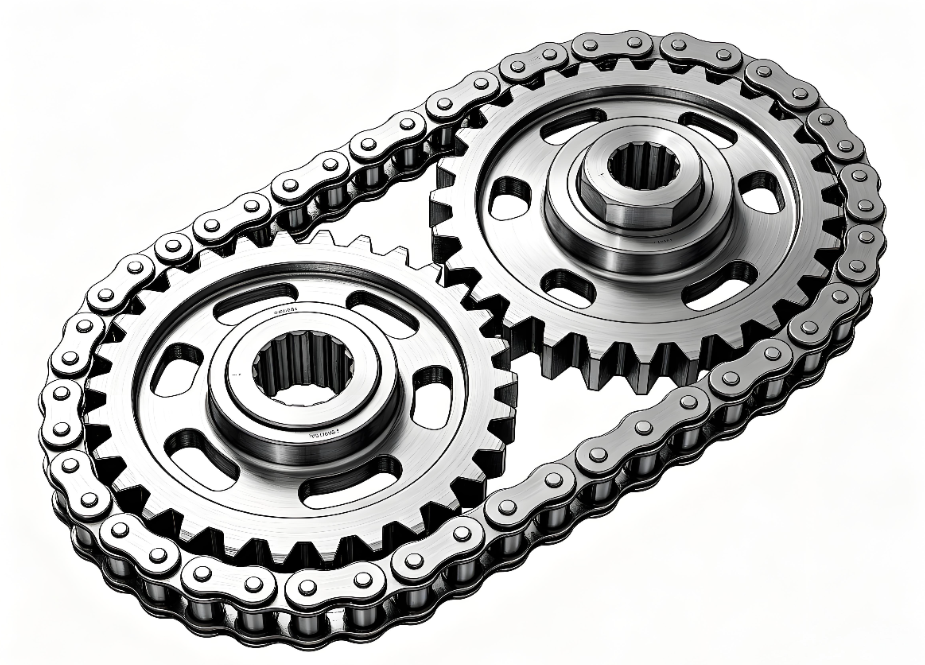
A chain drive uses a metal chain to transfer motion between sprockets. It connects a driving pulley (technically a sprocket) to a driven pulley, allowing torque to move from the driving shaft to the driven shaft.
Because it does not rely on friction, a chain drive ensures a constant speed ratio, making it suitable for precision machinery.
A belt drive uses a flexible belt—such as a flat belt or toothed belt—to transfer motion between pulleys. It is a frictional drive, meaning power is transmitted through friction between the belt and the pulleys.
The belt’s cross section (flat, V-shaped, or toothed) determines its performance and application.
| Feature | Chain Drive | Belt Drive |
|---|---|---|
| Power Transmission | Direct, no slip | Friction-based |
| Speed Ratio | Constant | May vary due to slip |
| Efficiency | High | Moderate |
| Noise | Noisy | Quiet |
| Maintenance | Requires lubrication | Minimal maintenance |
| Service Life | Long but depends on lubrication | Depends on belt material and tension |
| Shock Absorption | Low | Good, helps reduce vibration |
Belt drives come in several configurations depending on system layout and direction of rotation:
Both systems are essential in modern power transmission, with selection based on load, environment, and precision needs.
When selecting between chain and belt systems, consider:
For high torque and precision, chain drives are preferred. For smoother operation and lower noise, belt drives are more suitable.
It depends on the application. Chain drives offer higher efficiency and no slip, while belt drives provide smoother operation and lower noise.
The main drawback is slipping, especially in high-load conditions, since it is a frictional drive.
Yes, in low to moderate load applications. Using a toothed belt can help maintain a consistent speed ratio.
An idler pulley maintains proper tension and alignment, improving efficiency and extending belt life.
Factors include load, environment, lubrication (for chains), and material quality. Proper alignment and tension also play a major role.
Both chain and belt drives have distinct advantages. Chain drives deliver consistent performance under heavy loads, while belt drives offer flexibility, reduced noise, and the ability to reduce vibration. Understanding their differences helps in selecting the most suitable system for specific industrial applications.


