
Conveyor chains are widely used in manufacturing, warehousing, packaging, food processing, mining, automotive assembly, and many other industries. They provide reliable movement of products, components, and bulk materials through a production line while maintaining consistent operating performance.
Selecting the right conveyor chain can improve equipment efficiency, reduce maintenance requirements, and extend service life. With multiple chain designs available, understanding their differences helps engineers and purchasing teams choose the most suitable solution for their application.
This guide explains the major types of conveyor chains, their construction, applications, and selection considerations.
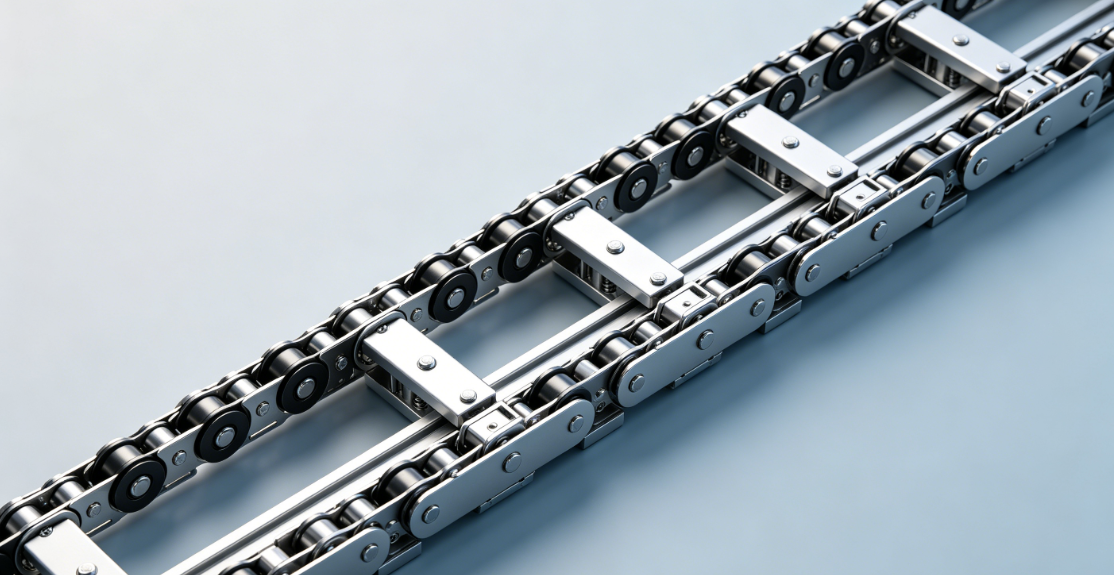
A conveyor chain is a mechanical chain designed to transport materials or products along a conveyor system. Unlike power transmission chains that primarily transfer rotational force, conveyor chains are engineered to carry loads and move items through a manufacturing or handling process.
A typical conveyor chain consists of:
The link plate forms the structural framework of the chain and helps distribute loads during operation.
Conveyor chains can be customized according to:
The most common types of conveyor chains include:
Each type is designed for specific load conditions, conveyor layouts, and operating environments.
The roller chain is one of the most widely used conveyor chain types. It features cylindrical rollers mounted between inner and outer link plates.
As the chain engages with sprockets, the rollers reduce friction and wear, allowing smooth movement.
Many factories use roller chains as the foundation of their conveyor equipment due to their proven performance and versatility.
Hollow pin chains use specially designed pins with internal openings.
These openings allow:
to be inserted without disassembling the chain.
Attachment chains are standard conveyor chains fitted with additional components.
Common attachment styles include:
Attachment chains are often selected when products must be positioned, lifted, pushed, or transferred during movement.
Double pitch chains are manufactured with a pitch twice that of standard roller chains.
Double pitch chains are commonly used in long-distance conveying applications where high-speed operation is not required.
Engineering steel chains are designed for heavy-duty industrial environments.
These chains are built to withstand demanding operating conditions and continuous heavy loads.
Welded steel chains are manufactured using welded steel components instead of traditional roller chain construction.
Their open design helps prevent material buildup during operation.
Leaf chains consist primarily of stacked link plate assemblies connected by pins.
Unlike roller chains, leaf chains do not use rollers.
Leaf chains are generally used for lifting rather than horizontal conveying.
Plastic conveyor chains are manufactured from engineering polymers.
Plastic chains perform well in wet and hygienic environments.
Table top chains feature interconnected flat surfaces that create a continuous conveying platform.
These chains are commonly found in modern automated production line systems.
Scraper chains move bulk materials using attached scrapers or flights.
The link plate is one of the most important structural elements within a conveyor chain.
Its functions include:
The quality of the link plate directly influences:
Manufacturers often use heat-treated alloy steel to improve the performance of link plates in demanding industrial applications.
Material selection depends on the operating environment and application.
Suitable for:
Advantages:
Suitable for:
Advantages:
Suitable for:
Advantages:
Suitable for:
Advantages:
When selecting a conveyor chain, consider the following factors:
Determine:
Higher speeds may require:
Evaluate exposure to:
Consider:
Choose a chain design that matches available maintenance resources and operating schedules.
Today's automated production line systems depend heavily on conveyor chains for efficient material movement.
Industries using conveyor chains include:
A properly selected conveyor chain helps maintain smooth workflow and consistent throughput while reducing downtime.
The roller chain is one of the most commonly used conveyor chains due to its durability, efficiency, and wide range of industrial applications.
A link plate connects chain components and carries tensile loads throughout the chain assembly, contributing to overall chain strength and durability.
Stainless steel conveyor chains and plastic conveyor chains are commonly used in food processing because they resist corrosion and support hygienic operations.
A roller chain is a specific chain design that can be used in both power transmission and conveying applications. Conveyor chains are designed primarily for material handling and product transportation.
Service life depends on operating conditions, load, lubrication, maintenance practices, and material quality. Properly maintained chains can operate for many years in industrial environments.
Engineering steel chains and welded steel chains are commonly selected for heavy-duty operations such as mining, cement production, and bulk material handling.
Conveyor chains are available in many designs, each developed to meet specific material handling requirements. From standard conveyor systems and automated production line equipment to heavy-duty mining operations, selecting the appropriate chain improves efficiency and supports reliable operation.
Whether choosing a roller chain for general conveying, an attachment chain for specialized handling, or an engineering steel chain for demanding environments, understanding chain construction, link plate design, material options, and application requirements helps ensure long-term performance and value.


