
Roller chains are among the most widely used mechanical components for power transmission. They are found in manufacturing equipment, agricultural machinery, conveyors, packaging systems, motorcycles, and industrial automation. Their ability to transfer power efficiently while handling heavy loads makes them a preferred solution across many industries.
To ensure compatibility between manufacturers and equipment, roller chains are produced according to internationally recognized standards. These standards define dimensions, materials, tolerances, and performance requirements, allowing chains and sprockets from different suppliers to work together.
This guide explains the major roller chain standards, how ANSI roller chain numbering works, the meaning of chain number, available materials such as stainless steel, differences between single and double strand chains, and how to choose the right chain and sprocket combination.
Roller chain standards establish uniform dimensions and performance requirements for industrial chains. The most widely used standard in North America is the American National Standards Institute (ANSI) standard, commonly referred to as ANSI roller chain. Standardized dimensions ensure that chains and sprockets from different manufacturers remain interchangeable while maintaining reliable power transmission.
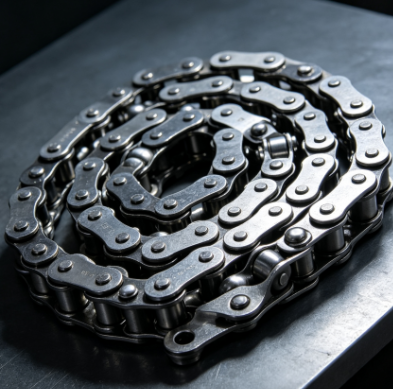
Roller chain standards define the physical dimensions and minimum performance requirements for industrial chains.
These standards specify:
Following a standard chain specification allows replacement parts to fit correctly without modifying equipment.
ANSI roller chain follows specifications published by the American National Standards Institute (ANSI). These standards are widely adopted throughout North America and many international markets.
The American National Standards Institute ANSI system establishes consistent dimensions so chains from different manufacturers can operate with the same sprockets.
ANSI roller chains are commonly used in:
Every ANSI chain is identified by a chain number, which provides information about its size.
Common examples include:
| Chain Number | Pitch | Typical Applications |
|---|---|---|
| ANSI #25 | 1/4 inch | Small machinery |
| ANSI #35 | 3/8 inch | Automation equipment |
| ANSI #40 | 1/2 inch | General industrial machinery |
| ANSI #50 | 5/8 inch | Conveyors |
| ANSI #60 | 3/4 inch | Heavy industrial equipment |
| ANSI #80 | 1 inch | Mining and manufacturing |
| ANSI #100 | 1-1/4 inch | Large power transmission systems |
Generally, a larger chain number indicates a larger pitch and higher load capacity.
A roller chain transfers rotational motion by engaging precisely with sprocket teeth.
As the driving sprocket rotates:
Compared with belt drives, roller chains provide positive engagement without slipping, making them suitable for demanding power transmission applications.
Understanding the construction of a roller chain makes it easier to evaluate product quality and service life.
Link plates connect all chain components and carry much of the tensile load during operation.
High-quality link plates provide:
Pins connect the chain links while allowing articulation as the chain travels around sprockets.
Bushings support the rollers and reduce friction between moving parts.
Rollers engage directly with sprocket teeth, reducing friction and minimizing wear.
Many buyers focus on tensile strengths, but tensile strength and working load are not the same.
Tensile strength refers to the maximum force required to break a chain under laboratory testing.
Working load represents the recommended continuous operating load after applying an appropriate safety factor.
Choosing a chain based solely on tensile strength may result in premature wear or reduced service life.
One of the most common decisions is selecting between single and double strand chains.
| Feature | Single Strand | Double Strand |
|---|---|---|
| Number of rows | 1 | 2 |
| Load capacity | Moderate | Higher |
| Suitable speed | Higher | Moderate |
| Cost | Lower | Higher |
| Typical applications | General machinery | Heavy-duty conveyors |
A double strand chain shares loads across two parallel rows, making it suitable for higher torque applications.
In addition to single and double configurations, manufacturers also produce strand chains with three, four, or more rows.
These chains are commonly used in:
Multi-row strand chains increase load capacity without changing chain pitch.
Some industrial environments demand more than standard chain performance.
Heavy duty roller chains typically feature:
Heavy duty chains are widely used in construction equipment, forestry machinery, mining operations, and steel production.
Stainless steel roller chains are designed for environments where corrosion resistance is more important than maximum load capacity.
Typical applications include:
Advantages include:
A chain performs best when matched with the correct chain and sprocket combination.
Important selection factors include:
Using mismatched sprockets increases wear and reduces transmission efficiency.
Several standards are used around the world.
| Standard | Primary Market |
|---|---|
| ANSI | North America |
| ISO | International |
| DIN | Germany and Europe |
| BS | United Kingdom |
| JIS | Japan |
Many manufacturers produce chains that comply with multiple international standards.
Proper maintenance helps maximize chain life and maintain efficient power transmission.
Recommended practices include:
Preventive maintenance often reduces downtime and replacement costs.
ANSI roller chains are used in a wide variety of industries, including:
Their standardized dimensions make maintenance easier and replacement parts more readily available.
Using a standard chain offers several benefits:
An ANSI roller chain is a roller chain manufactured according to specifications established by the American National Standards Institute (ANSI). Standardized dimensions allow chains and sprockets from different manufacturers to fit together correctly.
A chain number identifies the chain size, including its pitch and dimensional standard. Larger chain numbers generally indicate larger pitches and higher load capacities.
A heavy duty roller chain usually has thicker link plates, stronger pins, and greater fatigue resistance, making it suitable for applications involving higher shock loads or demanding operating conditions.
Stainless steel roller chains are recommended for wet, corrosive, or hygienic environments such as food processing, pharmaceutical production, marine applications, and chemical plants.
A properly matched chain and sprocket system improves transmission efficiency, reduces wear, minimizes vibration, and extends equipment service life.
A double strand roller chain consists of two parallel rows of chain links connected side by side. It offers greater load capacity than a single-strand chain while maintaining the same pitch.
Strand chains refer to roller chains with multiple parallel rows, including double, triple, and quadruple strand designs. They are used where higher power transmission capacity is required.
Roller chain standards provide the foundation for reliable, interchangeable power transmission systems across countless industries. Whether selecting an ANSI roller chain, understanding a chain number, comparing tensile strengths, choosing between double strand and multi-row strand chains, or specifying stainless steel for corrosive environments, following recognized standards helps ensure compatibility and dependable performance.
Selecting the correct chain and sprocket combination, maintaining proper lubrication, and choosing the appropriate chain construction for the application can significantly improve operating efficiency and extend equipment service life.


