
Roller chain is one of the most widely used power transmission components in industrial machinery. Whether you're replacing an existing chain or designing new equipment, selecting the correct standard is just as important as choosing the right size.
The two most common specifications are ANSI and DIN chain standards. While both define chain dimensions and performance requirements, they originated in different regions and are not always interchangeable.
This guide explains the differences between ANSI and DIN roller chain standards, their dimensional variations, applications, and how to choose the correct chain for your equipment.
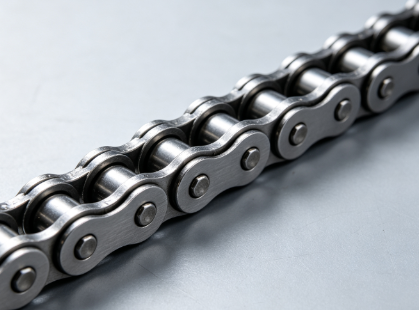
A roller chain standard specifies the dimensions, tolerances, materials, testing requirements, and identification methods used in manufacturing roller chains.
These standard covers help ensure that chains produced by different manufacturers remain interchangeable when they comply with the same specification.
The standard typically defines:
Without standardized dimensions, replacing chains and sprockets from different suppliers would become much more difficult.
The ANSI standard is primarily used in the United States, Canada, Mexico, and much of North America.
ANSI chain dimensions are defined under ANSI B29.1, a specification published by the American National Standards Institute.
ANSI B29.1 establishes requirements for:
Common ANSI chain sizes include:
| ANSI Chain | Pitch |
|---|---|
| #25 | 1/4" |
| #35 | 3/8" |
| #40 | 1/2" |
| #50 | 5/8" |
| #60 | 3/4" |
| #80 | 1" |
| #100 | 1-1/4" |
| #120 | 1-1/2" |
ANSI chains are commonly found in:
The DIN standard originated in Germany and is maintained by the Deutsches Institut für Normung, also known in English as the German Institute for Standardization.
Many DIN roller chain dimensions correspond with ISO 606, making them widely accepted as an international standard throughout Europe and many other markets.
DIN chains are commonly identified by their ISO numbers, such as:
DIN chains are widely used in:
Although ANSI and DIN chains perform the same basic function, several dimensional differences prevent many sizes from being directly interchangeable.
| Feature | ANSI | DIN |
|---|---|---|
| Main Region | United States & North America | Europe & many international markets |
| Governing Organization | American National Standards Institute | Deutsches Institut für Normung |
| Common Specification | ANSI B29.1 | DIN Standards / ISO 606 |
| Measurement Basis | Inch-based | Metric-based with ISO numbering |
| Chain Numbers | #40, #50, #60 | 08B, 10B, 12B |
| Sprocket Compatibility | ANSI sprockets | DIN sprockets |
Even when chain pitch appears similar, roller diameter, inner width, or plate thickness may differ.
Below are examples of comparable chain sizes.
| ANSI Chain | DIN Chain | Pitch |
|---|---|---|
| #40 | 08A | 1/2" |
| #50 | 10A | 5/8" |
| #60 | 12A | 3/4" |
| #80 | 16A | 1" |
It is important to note that DIN and ANSI chains with similar pitch are not automatically interchangeable.
Differences may include:
Always compare the full dimensional drawing before replacement.
ANSI B29.1 is the primary standard for precision power transmission roller chains in North America.
The specification includes:
Most reputable North American chain manufacturers design products according to ANSI B29.1.
The DIN standards for roller chains were developed by the German Institute for Standardization and later aligned with ISO requirements.
These standards specify:
Today, many European manufacturers produce chains that comply with both DIN and ISO standards.
In most situations, the answer is no.
Although some chain sizes have similar pitches, dimensional differences usually affect:
Using an ANSI chain on a DIN sprocket—or vice versa—may result in:
Whenever possible, replace both the chain and sprocket with matching standards.
Both ANSI and DIN specifications include multiple series chain configurations, such as:
Multi-strand chains provide higher load capacity while maintaining the same pitch.
Typical applications include:
The link plate connects adjacent chain pins and determines much of the chain's fatigue resistance.
Depending on the standard, link plate dimensions may vary in:
Premium manufacturers often optimize plate geometry to improve fatigue performance while remaining within the dimensional limits of the applicable standard.
Both ANSI and DIN standards include stainless steel versions for environments where corrosion resistance is important.
Common applications include:
Popular stainless steel grades include:
Compared with carbon steel chains, stainless steel chains offer:
The correct choice depends on your equipment rather than your location.
Choose ANSI when:
Choose DIN when:
If you are replacing a worn chain, verify:
Matching all dimensions is more reliable than comparing pitch alone.
Before placing an order:
ANSI and DIN are two well-established roller chain standards used in different regions around the world. ANSI chains are commonly used throughout the United States and North America under ANSI B29.1, while DIN standards developed by the Deutsches Institut für Normung form the basis for many European and ISO-compliant chains.
Although both standards describe similar products, differences in dimensions, numbering systems, and sprocket compatibility mean they should not be considered interchangeable without careful verification. Checking the complete specification before purchasing helps reduce installation issues and supports reliable equipment operation.
ANSI chains follow ANSI B29.1 and are commonly used in the United States and North America. DIN chains follow DIN standards, developed by the Deutsches Institut für Normung and closely aligned with ISO standards. Their dimensions and numbering systems differ, so they are not always interchangeable.
No. ANSI B29.1 and ISO 606 are different standards, although some chain pitches are similar. They define different dimensional details and chain numbering systems.
Generally, no. Differences in roller diameter, width, and other dimensions can lead to poor engagement, accelerated wear, and reduced service life.
DIN chains are widely used in Germany and many European countries. Because they align closely with ISO specifications, they are also common in many international markets.
Yes. Most manufacturers offer stainless steel roller chains that comply with both ANSI and DIN specifications for applications requiring corrosion resistance.
Check the chain markings, equipment manual, or measure key dimensions such as pitch, roller diameter, and inner width. Comparing these values with ANSI B29.1 or DIN dimensional tables will help identify the correct standard.


